Will DASH Save Us From The Format Wars?

Untitled

I saw a lot written lately about this new file format being proposed called MPEG DASH (stands for “Dynamic Adaptive Streaming over HTTP”).  I hear it was a big topic of discussion at the Streaming Media West conference recently.  The new standard is making its way through the ISO ratification process, and could be adopted by early next year.


Why is this big news?  The web is increasing going to be a place where people consume video content.  I recently saw someone refer to this time as the “videoization” of the internet.  But the problem is that we’ve got a number of competing formats and codecs, not to mention different devices, running a variety of Operating Systems and dozens of screen sizes and resolutions.  This market fragmentation makes it very hard to distribute video content efficiently.


The major movie studios adopted Ultraviolet, which standardizes their delivery format and encryption.  But the rest of us are still victims of the format wars between Microsoft, Apple, and Google, who all have competing (and incompatible), proprietary delivery formats.  With the Flash video format losing ground fast, it looks like MP4 will be the winner (using HTML5), so the possibility that all of the major players could agree on a delivery spec is enticing.


One potential fly in the ointment is that Mozilla (who’s Firefox has about a quarter of the browser market) is totally committed to an open source world.  They’ve said that they won’t implement DASH unless it’s royalty-free.  So that means that the other players will have to agree to make DASH royalty-free.  Which neither Microsoft or Apple have been willing to agree to in the past.  But it sure would be great if there was one, universally supported video delivery format.


Come on guys.  You’ve got enough of our money already.  Put aside the competition and rivalry to get something done that will help everyone.  Make it happen for the good of all, for once.

NY Times Posted Great Videos for Thanksgiving


Carving_vid

Last week, on the morning of Thanksgiving Day, I checked the New York Times home page just to see what was going on around the world.  I was surprised to see that the video window at the top of the page was devoted to a series of 5 short pieces about roasting a turkey, an activity that I was about to attempt just hours later.  A woman chef was dispensing advice on every stage of the process, from defrosting and unwrapping it, to letting it rest after it was cooked.


I had already printed out a recipe to try on my own bird this year, but watched the videos anyway, just out of curiosity.  And I learned a number of small tricks that helped me to successfully produce a beautiful roasted turkey (my first).  Keeping the oven closed, and forgoing the basting were among the bits of advice that she offered.  And so I did as she suggested.


Then, in the Dining section, there was another video, where a professional butcher discusses the best way to carve the turkey once it’s cooled down a bit.  I’d seen this one a couple of years ago, so it’s a “repeat”, but I watched it anyway, just to remind me of how it’s done (not at the table, is his advice).


So, to re-cap:  they provided me with short, concise content, that I found interesting and useful, especially because it was temporally relevant, even welcoming the re-published existing content, and I was grateful for the chance to watch the videos and learn something, which I promptly put to use in my own kitchen.


Damn, this web video stuff works well when it’s done right.

More Reasons to Use Web Videos for Marketing

An article I read recently stated that by 2013, Cisco predicts that 90% of online traffic will consist of video.  Pretty astounding.  But we don’t have to wait another year for the tipping point to come, because already more than 70% of online retail sites use video on their product pages.

What this means is that if you are a retail operation with an emarketing site, you are already behind the curve if you aren’t using video on that site.  And it’s becoming more prevalent for B2B marketers to use video, too.  There’s just no better way to engage and communicate with your audience (and potential customers) than video.  Increasingly, it will become what people expect to find when they get to your site.  If all you’ve got is a page of text with a still photo, you’re slackin’.

So what exactly can web videos be used for?  There are many options, and lots of examples of each already in the market, but here’s a short list:


– new product introductions

– product demos

– video FAQ’s or instructions

– video newsletters

– customer testimonials

– promotion of / recapping live events

– community building

– good old-fashioned advertising


I hesitated to put that last one on the list, because I think it’s a huge waste of the potential of web communication when clients take their traditional Broadcast commercials and put them online.  Most ads don’t work in a “pull” environment.  But, on the other hand, if the ad is interesting or entertaining enough, it can be a great (and cheap) way to distribute it.  Just check out how many hits the VW “The Force” ad got on YouTube as an example (over 44 million views so far).  So it works, but only for great content that your audience wants to see.

The biggest reason to use web video comes down to engaging the audience.  Nothing else comes close.  Now, this term “engagement” gets thrown around a lot lately, and I saw an interesting discussion about defining what it means the other day.  Beet TV sponsored a web panel in NY about online video and online advertising the other day (link to the program), called “The Value of Engagement”.   During one of the sessions, Jason Krebs from Tremor Video spoke about what it means to engage an audience.  Tremor recently started selling ads on a “per-engagement” basis, so this is not an academic issue.  They are staking their revenue stream on being able to deliver engagement (and they are the first, I believe, to do so).  What Jason said was that they defined engagement as causing the viewer to take some physical action, to click on something embedded in the video.  That “call to action” could be many things depending on the client’s strategy (a link to more info on a product, to a store locator, to an ecommerce site, etc.).  But the key point is that the viewer had to take some action, not just watch the video all the way through.

 That’s a pretty high bar compared to traditional measurements of advertising effectiveness (awareness or  positive opinion) so it’ll be interesting to see how often they achieve that result.  If they succeed, you can bet that many clients will want to be a part of that deal.  And we may have a new, better predictor of ROI, and measure of effectiveness, than ever before.

HTML5 is Now Dominant

Html5

Six months ago, a guy talking about the future of Interactive media quoted a study that said that about 30% of the browsers in use were HTML5 compliant (mostly because of Firefox, since they were an early adopter).  The other day another guy on a webinar said the figure was now 67%.  That’s quite an increase in just 6 months.  And by the first of the New Year, I would bet that figure will be over 80%, as people update their browsers to the latest version (IE9, for instance).

So now the majority of web experiences use the new HTML5 standards.  Add to this the recent news that Adobe will not be updating Flash for any new mobile OS, and you have a major shift in media distribution over the internet.  It was great to have Flash on 98% of the browsers for a couple of years.  It made it easy to distribute video and motion graphics.  But the shift to mobile doomed that technology. 

Apparently the Flash plug-in was unstable on mobile devices, causing them to crash, and using up too much power and processor resources.  I wrote about the shift in consumption to mobile devices here recently (hasn’t everyone?).  That doesn’t mean that Flash is dead, far from it.  It’s still ubiquitous, and the advice from the folks at Brightcove is that it should still be your first choice for a video distribution format.  But Flash alone won’t cut it anymore, and we’ll have to serve up multiple file formats for the foreseeable future.  We’re all caught up in another format war between the big tech companies, and it’s not likely that anyone will “win” anytime soon.  Even within a particular OS, there are differences from one device to another that may cause your file to play poorly or not at all.  So we’re stuck with complexity in serving media for a while. 

They are still referring to HTML5 as an “emerging” technology, but I’d say it’s already emerged, and by next year it’ll be the standard.  What this means is that any web site that was designed using earlier specs will need to be updated.  This was bought home to me personally recently.  I upgraded to the latest version of Firefox, and when I checked out my own site’s Home page, it didn’t display properly.  All of the blank areas, which were supposed to be black, showed up white (this only happened in Firefox, not in any of the other browsers).  It took me a couple of hours of digging to figure out what was going on.  It turns out that the <bgcolor> tag is not supported in the <body>  anymore, and you have to use CSS to control any of the style attributes in HTML5.

Those brilliant folks at W3C have created a great website to teach you all of the new rules and changes to the spec, which I found very helpful (http://www.w3schools.com).  It even shows you examples of HTML5 and CSS compliant code for each tag, which you can copy and paste into your site’s code.  Nice.  It’ll still be a lot of work to revise all of the web sites out there, but worth it, because the new <video> and <canvas> tags are going to make distributing videos and motion graphics so much easier.  Not to mention all of the cool new things designers will be able to do with them.  The multimedia party is about to start for real, and it’ll work just as well on mobile devices this time.

If you haven’t checked out your site using the latest Firefox browser (version 8), you should.  You may be surprised that the appearance or functionality of some elements don’t work anymore.  And then you’ll have to get it fixed, so that it’s HTML5 compliant.  But once that’s done, you should be cool for a long time.  It took about 7 years to get this new spec published, and it’ll be around for a long time.  Isn’t the web great?

What’s the Best Length for Web Videos?

Untitled

The short answer to this question is “shorter is better”, with one caveat.  As I mentioned in an earlier post, I think :15 spots are generally a waste of money.  It’s not enough time to develop a real story, and (with some notable exceptions) doesn’t usually communicate much of anything, except the sponsor’s logo.  It’s just long enough to be annoying, but not long enough to entertain, unless you’ve got a fabulous site gag that works in 10 seconds (that’s the exception).


Even :30’s always seemed to be a little tight to me.  I’ve noticed over the years how often the first assembly of a :30 spot comes in around 40 seconds.  Then we would squeezed it down and speed it up to make a :30, but that work usually compromised the communication and truncated the storytelling.  No one would ever know that unless you had seen the first cut, but it’s generally been true.


So my best guess is that videos should be between 45 seconds and 3 minutes.   That’s plenty of time to tell a good story, develop some drama, set up characters and situation for a comedic pay-off, or do a product demonstration.  But not so long as to bore anyone.  The research that’s been done to date says that video completion rates start to fall off fast after 3 minutes.   If the video is really interesting, and moves at a decent pace, you can stretch that to 5 minutes, but you’re tempting the audience to bail out before it’s over.


Mind you, we’re talking here about short web content, not a traditional TV series, with a stable cast and long dramatic arcs.  Those work on the web too, but only with massive amounts of promotion and exposure through traditional media first.  My kids watch “Glee” online all the time (it’s time-shifting for them), and have no trouble sticking with it until the end (although they don’t pay much attention to the commercials).


I mentioned the great documentary series that Honda has done for web distribution a while ago.  Those docs are between 15 and 20 minutes long.  I think they did a great job executing them, and I intended to go back and watch the rest of them.  But I haven’t.  Would I be more inclined to watch them all if they were shorter?  For sure.  Most people don’t have time in their day to spend 20 minutes watching a web video.  But they might do it after work if they considered it pure entertainment.  Again, that’s a different content category.


What to do if you have more than 3 minutes of stuff to say?  I have two suggestions.  First, I have been impressed with the way this is handled at Grovo (http://www.grovo.com).  This is a website that publishes videos meant to educate their audience about web technologies (how to use LinkedIn, for instance).  Many of their courses run 15 or 20 minutes total, but they’ve chosen to break them into smaller chapters that can be viewed individually, each chapter taking 2 or 3 minutes.  It’s a great strategy, because you can watch one or two, then if you get interrupted or bored, stop watching.  Then, when you have time, you can go back and pick up the next chapter in line.  It allows you to skip over sections that you already know or don’t have any interest in, too.  I think it works quite well.


The other strategy is to post multiple version of the content.  I produced a video to promote a local charity last year (babyspace.org), and the video turned out to be around 6 minutes.  We had much discussion about the length, knowing it was problematic.  And in then end, we cut a shorter version to post on the main web site that was around 3 minutes.  Then we also posted the full-length version to YouTube, and included a link to that version on the charity’s main web site.  That way we didn’t burden the casual viewer with content that was too long, but also allowed those who wanted to know more to see the longer version.  Problem solved.


So there you have it.  Avoid content that is too short to be of use, and that which is so long as to be tedious, and all will be well.  It’s always a judgment call, I know, but smart publishers will err on the shorter side.


Going Mobile

Aside from being a great song by The Who, “Going Mobile” is my subject this week.  I suspect that the increased importance of mobile devices to the media and marketing world will end up being one of the big stories of 2011 when the end-of-year navel gazing starts.

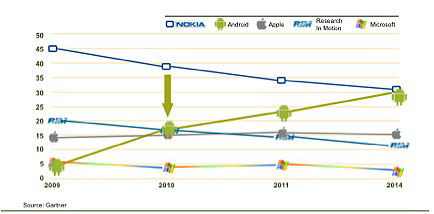
The proliferation of tablet computers and smart-phones has gotten to the point where more people are using them than connecting on traditional PCs.  The latest stats say there are 82 million smart-phones in use in this country (as of July 2011) and around 25 million other mobile computers (tablets).  So publishers and marketers and even TV networks can’t afford to ignore the trend.  We have to reach people where they live, and that’s increasingly on mobile devices.  But there are some significant technology hurdles that didn’t exist in the wired web distribution model.  First a little background on who’s using what platform.  Here’s a chart from a recent webinar that I attended:


Chart

As you can see, Nokia and RIM are tanking, and Android is gaining market share at an amazing pace.  Apple hangs in around 15%, though the Apple partisans are a technically sophisticated and well-off lot, and they can’t be ignored even though they are a small share of the market.  The Windows phone is not likely to ever achieve a major share of the market.  But the market is expected to remain fragmented in the future, with no one achieving even a 50% share.

The proliferation of devices and operating systems has created a highly fragmented market, making it impossible to reach everyone with one type of file.  And Apple’s refusal to allow Flash onto its mobile system has destroyed the ubiquity of the Flash platform (which was convenient for a couple of years).  Add to this complexity the variability in the mobile bandwidth as one moves around, and it has become really difficult to deliver a great experience in the mobile marketplace.

A number of companies have set up shop in this space and are offering what is known as ABR (Adaptive Bitrate technology).  I attended a webinar the other day sponsored by Streaming Media, that had 4 of these companies explaining their solutions to the mobile content distribution problem.  The companies on the program were:  Highwinds, Wowza Media Systems, Sorenson Media, and Harmonic.  Their intent is to provide the mobile user with the best viewing experience possible within the users current bandwidth, on any device and on any network.  That’s a neat trick, and involves storing the video file in numerous different versions, sensing the operating system and bandwidth that is in use when the request to connect comes in, and serving up the appropriate file in real time.

Here are some of the main points discussed:

– HTTP streaming is the future of the mobile delivery system (as opposed to RTMP, used in the Flash Player)

– H264, within an MP4 container is becoming the defacto standard for video

– Although each of the major technology players has their own proprietary video players, they are all nearly identical, so a standard such as H264 is possible

Thus, it is possible to serve up video on mobile devices successfully.  But it ain’t easy, and you will probably need help from a tech company like those mentioned above (and there are many others).  Otherwise, your video either won’t be seen at all, or the user’s experience will be so disappointing that it will prove detrimental to your marketing goals.  And we wouldn’t want that, now, would we?


Web Video as SEO

I recently read a digest of an eye-tracking study by a company called Mirametrix.  This type of study is done by a device that can track where a subjects eye’s move over a web page as they look at it, and it generates a “heat map” that shows what is viewed and for how long.  If you test enough subjects, you get a good idea of how the average person takes in all of the visual information on the page.

In the past, this has given us the typical “F” pattern that, by now, I suspect everyone has seen.  The graphic heat map shows brighter on those areas that are most viewed, and then trails off to nothing on areas which are not viewed at all.  The brightest part of the chart is always at the upper left corner (which is natural for those of us who read left-to-right).  This is also where the first search result can be found in a search list.  Then the map extends to the upper right, as the viewer glances over to the top right to check out the top paid result, then down to the second line on the left, and over to the right of that.  Then the viewer will scan down the left side of the page to see the other results, which trail off in brightness as the list goes on.

By the bottom of the page, the map shows a very faint image, meaning many of the test subjects never got that far.  This “F” pattern has been very consistent with text-based search results, and is the reason that web marketers go to such lengths to be at the top of the search results page.

The interesting thing in this new study was that when the test involved text and images (thumbnails of pictures or video), the pattern turned out to be very different, with the hottest area of the resulting heat map being over the imagery, even when it was in the middle or the bottom of the page.  So the “F” pattern was no longer the result, and depending on how the images were arranged, they determined where the subject’s eyes went and spent the most time.   This a bit of a game-changer.

People like pictures, it seems, more than plain text.  This shouldn’t come as a shock to anyone, but it does have interesting ramifications on how to attract attention on the ever-more-crowded web.  Video makes a big difference, especially now that Google and others are including video thumbnails in their search results.  One could  argue that if your site doesn’t include video (or at least some stills that will turn up as thumbnails), you are lagging behind other online marketers, and getting lost in the visual noise on the results page.

There were a couple of interesting statistics thrown around last week by speakers at the MIMA Summit.  One was that only 2% of visitors to an ecommerce site made a purchase.  But the same speaker also pointed out that the click-through rate for videos was around 80%.  People like to see what the video is about.  Of course they may be disappointed and leave before completing it (check your bounce rate), but at least they give it a look.  In order to keep them watching, and deliver some value, the videos need to be useful to them (entertaining, informative, beautiful, or temporally relevant, as my earlier post suggests).  If the consumer watches the video, it’s likely that 2% conversion rate can be improved on.  And if it’s really cool, you may even get some free exposure to that viewer’s social connections, through earned media, which is what everyone hopes will happen.

There’s one more statistic I heard recently, that is interesting, and this one comes from a report on online video by Brightcove.  They claim that a site with video on it is 52 times more likely to wind up on the first page of search results than one without.  I can’t say how they came to that conclusion, or vouch for the accuracy of their study, but if it’s even close to the truth, it a pretty impressive advantage.

The take-away is that if you’re not serving up engaging video content as part of your on-line marketing, then you’re losing out on one of the most powerful ways to attract and influence an audience on-line.  And it’s become so easy to add video to a web site now, that there’s no excuse not to do it.  If you don’t have anyone in-house who can make that happen, get in touch with me.  I’d be happy to help.


Conference Week in Minneapolis

There were two major industry events this week here in MN, back to back.  On Monday the AICP had their annual showing of the MOMA “Art & Technique of the American Commercial” reel.  And then on Tuesday and Wednesday the annual MIMA Summit was held (Minnesota Interactive Marketing Association / mima.org).

The best thing about the AICP show was the afternoon program devoted to the “Next Awards”.  I would encourage everyone to attend if possible.  Unlike the traditional MOMA reel, which just shows the work that has been selected, the Next program featured commentary by various industry bigwigs about the emerging trends in all of the categories.  Plus the winners themselves were represented by detailed case studies, so you got a good understanding of the thinking that went into them and the technology that was applied to pull them off.  Very cool stuff, some of which I hadn’t seen before, and I learned a lot.

Highlights from the Next Awards included:

Nike “Write The Future” campaign

Target “Kaleidoscopic Fashion Spectacular”

Old Spice “Smell Like A Man” campaign

Gatorade “Replay, Season 2”

The Johnny Cash Project

All of these are well worth checking out if you haven’t seen them.  Some of the material is posted under the “show archives” section of the AICP show web site (http://www.aicpshow.com/), and the commentary can be found on YouTube ()

I did not attend the first half-day of the MIMA Summit, but went to the full day program on Wednesday.  There were 10 different tracks that had presentations for each of the 4 sessions, so everyone’s experience was a little different.  For me, the highlight was the early morning keynote from Avinash Kaushik (http://www.kaushik.net/avinash/).  Avinash is a passionate evangelist for web analytics, and the author of two books on the subject.  And he is also quite funny.

He had done his homework before coming to Minneapolis, and had numerous examples of terrible web marketing from some of our biggest home-town companies.  He was especially derisive in his remarks about some web coupon offers from General Mills (deservedly so).  He also pointed out how lame many of the sites were when accessed by mobile devices, sometimes not showing up at all (in the case of Flash-based sites viewed on an ipad).  I think by now, everyone involved in web-based commerce should know that they need a mobile-optimized HTML5 version of their site available, and the technology to detect the user’s operating system.

He was complimentary of some of the Target sites, so they escaped unscathed.  He was quite funny overall, which helped a talk about web analytics at 8 AM, and I will share two of his home made acronyms as example:

HITS + How Idiots Tabulate Success

HIPPO + Highest Paid Person’s Opinion

The other session I saw that was great was Edward Boches (http://edwardboches.com/) and David Amano(http://darmano.typepad.com/) talking about the challenges in creating Innovation within a Traditional Agency environment (of which there are many).  They had an amusing “therapy” approach and invited anyone with a problem with their Agency to join them on a couch to get their advice.

Of course, both events were followed by cocktail parties, so much schmoozing and merriment was had by all.  And I got to see a lot of folks that I hadn’t seen in a long time at the AICP party.  Which, as the saying goes, didn’t suck.


3 Essentials for Online Video

The most obvious and important aspect of getting your video content seen on the web is to have great content.  I have always been a believer in the “content is king” dictum, and it is even truer than ever in a “pull” media world.  You can read my earlier post about what makes for engaging content, here.

Great content is the most important thing, and mostly what the purveyors of content occupy themselves thinking about and figuring out.  But it’s not everything.  There are two other essential elements to a successful content strategy, which are less often discussed, but just as important:  Promotion and Delivery

Promotion

Nothing attracts an audience without paid promotion.  That goes for books, plays, movies, TV shows, and anything else you can imagine.  Just take a look at the amount of money the networks commit to promoting a new series they plan to broadcast, and you’ll get an idea of how important promotion is in the media world.

So if you want your content to be seen (and that is the point, isn’t it?), then you need to plan for (and budget for) promotion.  Which is not to say that you can’t get some nearly “free” promotion on social media.  That doesn’t hurt, and can gain your videos some traction.  But it’s not enough.  So assume that some money will need to be spent on paid search, display ads, and even some traditional media.  The media mix will depend on your intended target, and that’s a big subject all by itself, which I can’t get into here.  But there are plenty of pros out there willing to help you figure out a Promotional plan (for a price).

And for those who are certain that their video will go “viral” and attract millions of views without any paid promotion … get off the pipe.  It’s extremely rare.  And if you examine the darlings of the viral video phenomenon, you will usually see a significant effort to start the ball rolling with paid promotion.  If the video then takes off and garners a considerable amount of earned media exposure, then you’ve scored and can consider it a great success.  But if you don’t give it some promotion to start, it’s very unlikely it’ll get much attention.

Delivery

The last piece of this puzzle is actually delivering the videos to the consumers.  Since this is an area that is mostly technical, it’s not top of mind for most marketers.  But it’s essential.  Yes, you can load the videos up to a YouTube channel and hope for the best, but I’m talking about a marketing effort that makes engaging content one of it’s pillars, but that also includes direct-purchase or consumer relations aspects.  Which means you’ll want to serve the videos from an owned portal of some sort:  either a dedicated microsite, or an adjunct area of the main web site.  Syndication to other sites doesn’t hurt (YouTube, et al.), and that can help drive traffic, but again, that’s a separate issue all on it’s own.

You will need to plan for the possibility that your videos will achieve significant scale (just in case the effort is successful).  That means that you could be serving a couple of thousand requests one day, and then a million the next, with no advance warning.  So you need a server technology partner that will provide the scaling necessary in real time, and the technical infrastructure to keep your site online no matter what.  I learned this during one of my first forays into the online video realm.  We produced a number a very good videos for the client’s site, but the client insisted on serving them from their own internal company servers.  This didn’t work very well.  If the consumer actually chooses to come to your site and clicks on a video, they expect it to play without much delay, and without stopping every 10 seconds to buffer.

How many times would you think someone is going to return to your site if they have an unsatisfactory experience there the first time?  My guess would be never.  So not only do you lose the potential positive outcome from that interaction, but you probably lost that individual forever.  Bad move.  Don’t cheap out on the delivery.

There are a couple of acronyms that you need to learn.  The first is DSA, for Dynamic Site Acceleration.  I won’t try to explain the technology here, but suffice to say that there are companies that will make sure your site behaves responsively as the bandwidth usage increases (Akamai & AT&T seem to be leaders in this area).  So if you do get a lot of traffic, it won’t slow your service to a crawl.

The other is ABR, Adaptive Bit Rate technology.  With the importance of mobile access increasing, this has become a hot issue.  Basically, the companies selling this technology have a way to figure out what device the consumer is connected with (operating system, screen size, bandwidth), and then serve them the file that will produce the best visual experience based on those parameters.  That may be a somewhat less than optimal version of your content, but it beats a spinning icon waiting for the content to download.  My own (admittedly ad-hoc) research suggests that most people will give up on it and click away within 10 seconds.

As a guy I heard speak in NY recently said, these are “high class problems”, and will only become an issue if you get a lot of traffic.  But isn’t that why you created the content in the first place?  Consumers are getting used to first-rate experiences on-line no mater how they are connected, and so the bar keeps getting raised.  You’ve got to keep up with those expectations, or re-evaluate your strategy if that’s not feasible.

Figuring out how to get consumers to watch your content (promotion), and planning for the day when your videos get a million hits (distribution), are absolutely necessary in the early stages of project planning.