Going Mobile

Aside from being a great song by The Who, “Going Mobile” is my subject this week.  I suspect that the increased importance of mobile devices to the media and marketing world will end up being one of the big stories of 2011 when the end-of-year navel gazing starts.

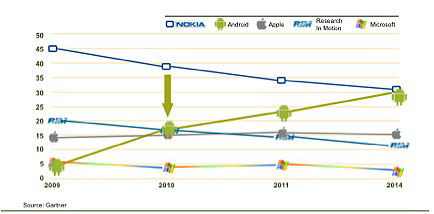
The proliferation of tablet computers and smart-phones has gotten to the point where more people are using them than connecting on traditional PCs.  The latest stats say there are 82 million smart-phones in use in this country (as of July 2011) and around 25 million other mobile computers (tablets).  So publishers and marketers and even TV networks can’t afford to ignore the trend.  We have to reach people where they live, and that’s increasingly on mobile devices.  But there are some significant technology hurdles that didn’t exist in the wired web distribution model.  First a little background on who’s using what platform.  Here’s a chart from a recent webinar that I attended:
 

Chart

As you can see, Nokia and RIM are tanking, and Android is gaining market share at an amazing pace.  Apple hangs in around 15%, though the Apple partisans are a technically sophisticated and well-off lot, and they can’t be ignored even though they are a small share of the market.  The Windows phone is not likely to ever achieve a major share of the market.  But the market is expected to remain fragmented in the future, with no one achieving even a 50% share.

The proliferation of devices and operating systems has created a highly fragmented market, making it impossible to reach everyone with one type of file.  And Apple’s refusal to allow Flash onto its mobile system has destroyed the ubiquity of the Flash platform (which was convenient for a couple of years).  Add to this complexity the variability in the mobile bandwidth as one moves around, and it has become really difficult to deliver a great experience in the mobile marketplace.

A number of companies have set up shop in this space and are offering what is known as ABR (Adaptive Bitrate technology).  I attended a webinar the other day sponsored by Streaming Media, that had 4 of these companies explaining their solutions to the mobile content distribution problem.  The companies on the program were:  Highwinds, Wowza Media Systems, Sorenson Media, and Harmonic.  Their intent is to provide the mobile user with the best viewing experience possible within the users current bandwidth, on any device and on any network.  That’s a neat trick, and involves storing the video file in numerous different versions, sensing the operating system and bandwidth that is in use when the request to connect comes in, and serving up the appropriate file in real time.

Here are some of the main points discussed:

– HTTP streaming is the future of the mobile delivery system (as opposed to RTMP, used in the Flash Player)

– H264, within an MP4 container is becoming the defacto standard for video

– Although each of the major technology players has their own proprietary video players, they are all nearly identical, so a standard such as H264 is possible

Thus, it is possible to serve up video on mobile devices successfully.  But it ain’t easy, and you will probably need help from a tech company like those mentioned above (and there are many others).  Otherwise, your video either won’t be seen at all, or the user’s experience will be so disappointing that it will prove detrimental to your marketing goals.  And we wouldn’t want that, now, would we?


Web Video as SEO

I recently read a digest of an eye-tracking study by a company called Mirametrix.  This type of study is done by a device that can track where a subjects eye’s move over a web page as they look at it, and it generates a “heat map” that shows what is viewed and for how long.  If you test enough subjects, you get a good idea of how the average person takes in all of the visual information on the page.

In the past, this has given us the typical “F” pattern that, by now, I suspect everyone has seen.  The graphic heat map shows brighter on those areas that are most viewed, and then trails off to nothing on areas which are not viewed at all.  The brightest part of the chart is always at the upper left corner (which is natural for those of us who read left-to-right).  This is also where the first search result can be found in a search list.  Then the map extends to the upper right, as the viewer glances over to the top right to check out the top paid result, then down to the second line on the left, and over to the right of that.  Then the viewer will scan down the left side of the page to see the other results, which trail off in brightness as the list goes on.

By the bottom of the page, the map shows a very faint image, meaning many of the test subjects never got that far.  This “F” pattern has been very consistent with text-based search results, and is the reason that web marketers go to such lengths to be at the top of the search results page.

The interesting thing in this new study was that when the test involved text and images (thumbnails of pictures or video), the pattern turned out to be very different, with the hottest area of the resulting heat map being over the imagery, even when it was in the middle or the bottom of the page.  So the “F” pattern was no longer the result, and depending on how the images were arranged, they determined where the subject’s eyes went and spent the most time.   This a bit of a game-changer.

People like pictures, it seems, more than plain text.  This shouldn’t come as a shock to anyone, but it does have interesting ramifications on how to attract attention on the ever-more-crowded web.  Video makes a big difference, especially now that Google and others are including video thumbnails in their search results.  One could  argue that if your site doesn’t include video (or at least some stills that will turn up as thumbnails), you are lagging behind other online marketers, and getting lost in the visual noise on the results page.

There were a couple of interesting statistics thrown around last week by speakers at the MIMA Summit.  One was that only 2% of visitors to an ecommerce site made a purchase.  But the same speaker also pointed out that the click-through rate for videos was around 80%.  People like to see what the video is about.  Of course they may be disappointed and leave before completing it (check your bounce rate), but at least they give it a look.  In order to keep them watching, and deliver some value, the videos need to be useful to them (entertaining, informative, beautiful, or temporally relevant, as my earlier post suggests).  If the consumer watches the video, it’s likely that 2% conversion rate can be improved on.  And if it’s really cool, you may even get some free exposure to that viewer’s social connections, through earned media, which is what everyone hopes will happen.

There’s one more statistic I heard recently, that is interesting, and this one comes from a report on online video by Brightcove.  They claim that a site with video on it is 52 times more likely to wind up on the first page of search results than one without.  I can’t say how they came to that conclusion, or vouch for the accuracy of their study, but if it’s even close to the truth, it a pretty impressive advantage.

The take-away is that if you’re not serving up engaging video content as part of your on-line marketing, then you’re losing out on one of the most powerful ways to attract and influence an audience on-line.  And it’s become so easy to add video to a web site now, that there’s no excuse not to do it.  If you don’t have anyone in-house who can make that happen, get in touch with me.  I’d be happy to help.


Conference Week in Minneapolis

There were two major industry events this week here in MN, back to back.  On Monday the AICP had their annual showing of the MOMA “Art & Technique of the American Commercial” reel.  And then on Tuesday and Wednesday the annual MIMA Summit was held (Minnesota Interactive Marketing Association / mima.org).

The best thing about the AICP show was the afternoon program devoted to the “Next Awards”.  I would encourage everyone to attend if possible.  Unlike the traditional MOMA reel, which just shows the work that has been selected, the Next program featured commentary by various industry bigwigs about the emerging trends in all of the categories.  Plus the winners themselves were represented by detailed case studies, so you got a good understanding of the thinking that went into them and the technology that was applied to pull them off.  Very cool stuff, some of which I hadn’t seen before, and I learned a lot.

Highlights from the Next Awards included:

Nike “Write The Future” campaign

Target “Kaleidoscopic Fashion Spectacular”

Old Spice “Smell Like A Man” campaign

Gatorade “Replay, Season 2”

The Johnny Cash Project

All of these are well worth checking out if you haven’t seen them.  Some of the material is posted under the “show archives” section of the AICP show web site (http://www.aicpshow.com/), and the commentary can be found on YouTube ()

I did not attend the first half-day of the MIMA Summit, but went to the full day program on Wednesday.  There were 10 different tracks that had presentations for each of the 4 sessions, so everyone’s experience was a little different.  For me, the highlight was the early morning keynote from Avinash Kaushik (http://www.kaushik.net/avinash/).  Avinash is a passionate evangelist for web analytics, and the author of two books on the subject.  And he is also quite funny.

He had done his homework before coming to Minneapolis, and had numerous examples of terrible web marketing from some of our biggest home-town companies.  He was especially derisive in his remarks about some web coupon offers from General Mills (deservedly so).  He also pointed out how lame many of the sites were when accessed by mobile devices, sometimes not showing up at all (in the case of Flash-based sites viewed on an ipad).  I think by now, everyone involved in web-based commerce should know that they need a mobile-optimized HTML5 version of their site available, and the technology to detect the user’s operating system.

He was complimentary of some of the Target sites, so they escaped unscathed.  He was quite funny overall, which helped a talk about web analytics at 8 AM, and I will share two of his home made acronyms as example:

HITS + How Idiots Tabulate Success

HIPPO + Highest Paid Person’s Opinion

The other session I saw that was great was Edward Boches (http://edwardboches.com/) and David Amano(http://darmano.typepad.com/) talking about the challenges in creating Innovation within a Traditional Agency environment (of which there are many).  They had an amusing “therapy” approach and invited anyone with a problem with their Agency to join them on a couch to get their advice.

Of course, both events were followed by cocktail parties, so much schmoozing and merriment was had by all.  And I got to see a lot of folks that I hadn’t seen in a long time at the AICP party.  Which, as the saying goes, didn’t suck.


3 Essentials for Online Video

The most obvious and important aspect of getting your video content seen on the web is to have great content.  I have always been a believer in the “content is king” dictum, and it is even truer than ever in a “pull” media world.  You can read my earlier post about what makes for engaging content, here.

Great content is the most important thing, and mostly what the purveyors of content occupy themselves thinking about and figuring out.  But it’s not everything.  There are two other essential elements to a successful content strategy, which are less often discussed, but just as important:  Promotion and Delivery

Promotion

Nothing attracts an audience without paid promotion.  That goes for books, plays, movies, TV shows, and anything else you can imagine.  Just take a look at the amount of money the networks commit to promoting a new series they plan to broadcast, and you’ll get an idea of how important promotion is in the media world.

So if you want your content to be seen (and that is the point, isn’t it?), then you need to plan for (and budget for) promotion.  Which is not to say that you can’t get some nearly “free” promotion on social media.  That doesn’t hurt, and can gain your videos some traction.  But it’s not enough.  So assume that some money will need to be spent on paid search, display ads, and even some traditional media.  The media mix will depend on your intended target, and that’s a big subject all by itself, which I can’t get into here.  But there are plenty of pros out there willing to help you figure out a Promotional plan (for a price).

And for those who are certain that their video will go “viral” and attract millions of views without any paid promotion … get off the pipe.  It’s extremely rare.  And if you examine the darlings of the viral video phenomenon, you will usually see a significant effort to start the ball rolling with paid promotion.  If the video then takes off and garners a considerable amount of earned media exposure, then you’ve scored and can consider it a great success.  But if you don’t give it some promotion to start, it’s very unlikely it’ll get much attention.

Delivery

The last piece of this puzzle is actually delivering the videos to the consumers.  Since this is an area that is mostly technical, it’s not top of mind for most marketers.  But it’s essential.  Yes, you can load the videos up to a YouTube channel and hope for the best, but I’m talking about a marketing effort that makes engaging content one of it’s pillars, but that also includes direct-purchase or consumer relations aspects.  Which means you’ll want to serve the videos from an owned portal of some sort:  either a dedicated microsite, or an adjunct area of the main web site.  Syndication to other sites doesn’t hurt (YouTube, et al.), and that can help drive traffic, but again, that’s a separate issue all on it’s own.

You will need to plan for the possibility that your videos will achieve significant scale (just in case the effort is successful).  That means that you could be serving a couple of thousand requests one day, and then a million the next, with no advance warning.  So you need a server technology partner that will provide the scaling necessary in real time, and the technical infrastructure to keep your site online no matter what.  I learned this during one of my first forays into the online video realm.  We produced a number a very good videos for the client’s site, but the client insisted on serving them from their own internal company servers.  This didn’t work very well.  If the consumer actually chooses to come to your site and clicks on a video, they expect it to play without much delay, and without stopping every 10 seconds to buffer.

How many times would you think someone is going to return to your site if they have an unsatisfactory experience there the first time?  My guess would be never.  So not only do you lose the potential positive outcome from that interaction, but you probably lost that individual forever.  Bad move.  Don’t cheap out on the delivery.

There are a couple of acronyms that you need to learn.  The first is DSA, for Dynamic Site Acceleration.  I won’t try to explain the technology here, but suffice to say that there are companies that will make sure your site behaves responsively as the bandwidth usage increases (Akamai & AT&T seem to be leaders in this area).  So if you do get a lot of traffic, it won’t slow your service to a crawl.

The other is ABR, Adaptive Bit Rate technology.  With the importance of mobile access increasing, this has become a hot issue.  Basically, the companies selling this technology have a way to figure out what device the consumer is connected with (operating system, screen size, bandwidth), and then serve them the file that will produce the best visual experience based on those parameters.  That may be a somewhat less than optimal version of your content, but it beats a spinning icon waiting for the content to download.  My own (admittedly ad-hoc) research suggests that most people will give up on it and click away within 10 seconds.

As a guy I heard speak in NY recently said, these are “high class problems”, and will only become an issue if you get a lot of traffic.  But isn’t that why you created the content in the first place?  Consumers are getting used to first-rate experiences on-line no mater how they are connected, and so the bar keeps getting raised.  You’ve got to keep up with those expectations, or re-evaluate your strategy if that’s not feasible.

Figuring out how to get consumers to watch your content (promotion), and planning for the day when your videos get a million hits (distribution), are absolutely necessary in the early stages of project planning.